









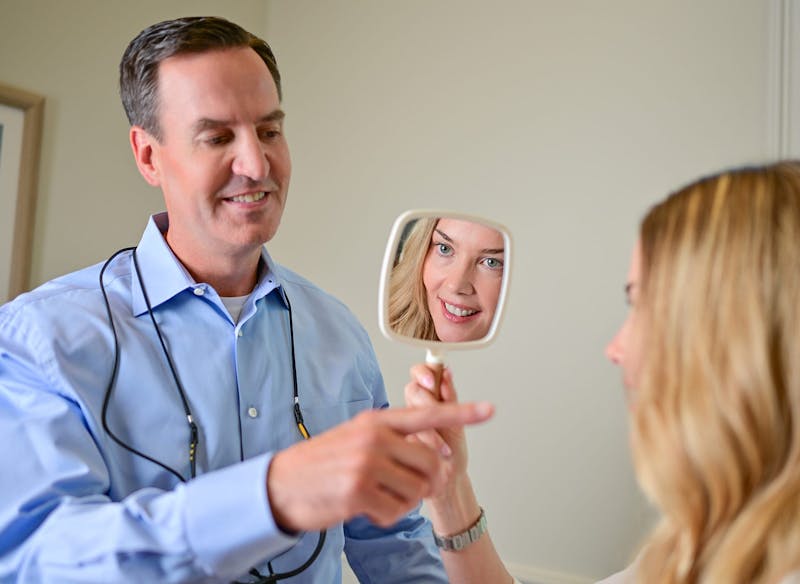


The facial aging process is complex and volume loss is a substantial component. Replacement of facial volume loss can be accomplished through the use of autologous fat transfer, which is using the patient’s own body fat cells and transplanting them into the face, or through the use of syringe based fillers. The most common types of fillers used are hyaluronic acid (Restylane, Perlane, Juvederm) and calcium hydroxylapetite. (Radiesse) Poly-L Lactic acid (Sculptra) is another filler which can be used for volume loss however it requires multiple treatments to appreciate the results and therefore we do not frequently use it. We prefer to use Radiesse for subcutaneous tissue augmentation as the results are immediate and the longevity approaches that of sculptra. Autologous fat transfer is another topic for another Blog. We will talk more about the use of syringe based fillers.
We usually use a combination approach for overall facial rejuvenation with fillers. We utilized Restylane for the teartrough deformity of the lower eyelid, Radiesse for deep cheek augmentation, and then a combination of Restylane, Perlane and Juvederm for perioral rejuvenation. The tear trough or orbital groove is a hollow at the junction of the lower eyelid and cheek. It is responsible for giving the lower eyelids their bag-like tired appearance. Restylane is very useful for filling in this groove. By filling up the hollow it changes the way light catches the eyelid cheek junction removing the appearance of the tired eye and adding light and therefore a refreshed appearance.
The loss of volume of the lower eyelid usually extends into the cheek region as well into what is referred to as a malar groove. It is an oblique line that separates from the orbital groove and extends down the cheek. When present the cheek has lost is youthful fullness and become a series of lumps and hollows again creating unsightly shadows. In this area we prefer to use Radiesse or Perlane to add the youthful fullness back to the cheek.
The other common area for facial rejuvination is the perioral area including the smile lines, marionett lines, and the pre-jowl sulcus which is the hollow along the jaw-line just in front of the jowl. By adding volume to this area the lines of age are again filled out to a more youthful configuration. The pre-jowl sulcus being filled hides the appearance of the jowl and leads to a cleaner looking jaw-line.
Fillers are great because of their ease of use and limited down-time. Dramatic results can be obtained through their use, especially if a total facial approach is utilized.
Mary,
The timing of a facelift with regard to weight loss is not really important. A facelift is designed to improve the jawline and neck. The excess fat that exists in the neck will be removed during the procedure and so it is not necessary to lose the weight first. Having said that, significant weight loss in the face can lead to aging of the cheeks and lower eyelids. This can be corrected with a facial fat transfer. Usually the timing of this is not that important as long as you are not losing large quantities of weight. I usually use 30-40 pounds as a rough guideline of enough weight to make a difference. As long as you don’t have that amount of weight or more to lose then I feel it is OK to proceed with a facelift or fat transfer.
Ed Buckingham
Jason,
It is a little unusual for a 27 year old to have loose skin on their face following weight loss of even a significant degree. Usually at that age the skin has enough elasticity to accommodate the loss of volume. In general however, loss of weight produces a loss of overall subcutaneous volume in the face. This can lead to the loss of skin tone or facial structural shape in a young person, and an aging appearance in an older person. Loss of volume in the cheek and area around the eyes can be replaced by performing a fat transfer. This involves harvesting remaining fat from the body or lower limbs and placing it into the appropriate areas of the face to add contour. This can include augmenting the cheeks or jaw area. Sagging neck skin usually is dealt with by performing a surgical procedure to tighten the skin. There is some anecdotal discussion about lasers producing skin tightening, but I have never been impressed with this in the neck. In someone of your age usually a tightening of the neck musculature called a platysmaplasty will be sufficient.
The best way for me to address your specific concerns is to come in for a consultation. There we would be able to discuss the procedures in more detail and be certain to meet your goals.
Ed Buckingham
Nora,
The answer is it would depend. I have done fat grafting for a nose on one occasion and it worked quite well, but it was a generalized depression from an injury and not a rhinoplasty defect. We would just have to look at your concerns and decide whether fat grafting would be an option. I have also used Restylane for post rhinoplasty defects. It works quite well, and while you do have to repeat the treatment it lasts about a year. Let us know if we can help you further.
Ed Buckingham
Marilyn,
Thanks for your question regarding down-time related to doing multiple procedures. You mentioned facelift, fat transfer and blepharoplasty. We talk about down-time in two categories. Social downtime- when will you look OK to return to routine social functions, not necessarily be in a wedding however. Total downtime- when will you look completely healed and as good as it gets. (not including things like the scar maturing to a complete white line, ie. it may be a little red after this time period) The down-time from doing multiple procedures is dictated by the procedure performed with the longest downtime. In your case that would be the fat transfer. A facelift or blepharoplasty each has about a week of social down-time and about 6 weeks to 3 months of total down-time, again this is not really downtime, but is a good judge of when you could say take photos for something important. The fat transfer has 2 weeks of social down-time for small and medium quantity transfers (10-30 cc) and as long as 3 weeks for larger transfers. The total down-time is again 6-12 weeks.
I hope this has been helpful. We would be happy to talk about this further with you at your convenience.
Ed Buckingham