

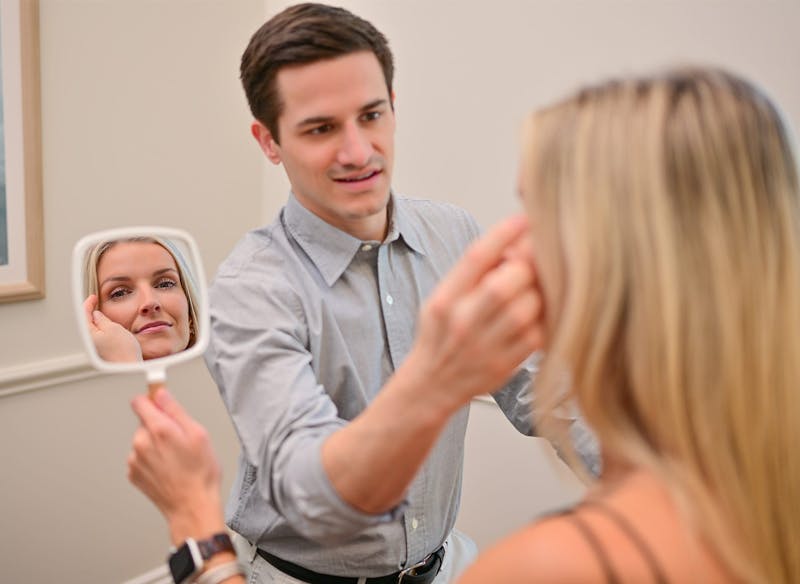
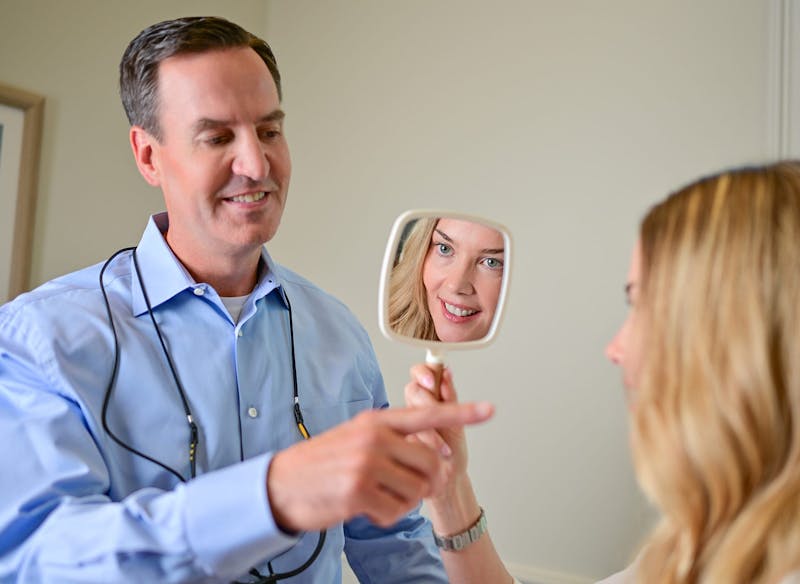


The facial aging process is complex and volume loss is a substantial component. Replacement of facial volume loss can be accomplished through the use of autologous fat transfer, which is using the patient’s own body fat cells and transplanting them into the face, or through the use of syringe based fillers. The most common types of fillers used are hyaluronic acid (Restylane, Perlane, Juvederm) and calcium hydroxylapetite. (Radiesse) Poly-L Lactic acid (Sculptra) is another filler which can be used for volume loss however it requires multiple treatments to appreciate the results and therefore we do not frequently use it. We prefer to use Radiesse for subcutaneous tissue augmentation as the results are immediate and the longevity approaches that of sculptra. Autologous fat transfer is another topic for another Blog. We will talk more about the use of syringe based fillers.
We usually use a combination approach for overall facial rejuvenation with fillers. We utilized Restylane for the teartrough deformity of the lower eyelid, Radiesse for deep cheek augmentation, and then a combination of Restylane, Perlane and Juvederm for perioral rejuvenation. The tear trough or orbital groove is a hollow at the junction of the lower eyelid and cheek. It is responsible for giving the lower eyelids their bag-like tired appearance. Restylane is very useful for filling in this groove. By filling up the hollow it changes the way light catches the eyelid cheek junction removing the appearance of the tired eye and adding light and therefore a refreshed appearance.
The loss of volume of the lower eyelid usually extends into the cheek region as well into what is referred to as a malar groove. It is an oblique line that separates from the orbital groove and extends down the cheek. When present the cheek has lost is youthful fullness and become a series of lumps and hollows again creating unsightly shadows. In this area we prefer to use Radiesse or Perlane to add the youthful fullness back to the cheek.
The other common area for facial rejuvination is the perioral area including the smile lines, marionett lines, and the pre-jowl sulcus which is the hollow along the jaw-line just in front of the jowl. By adding volume to this area the lines of age are again filled out to a more youthful configuration. The pre-jowl sulcus being filled hides the appearance of the jowl and leads to a cleaner looking jaw-line.
Fillers are great because of their ease of use and limited down-time. Dramatic results can be obtained through their use, especially if a total facial approach is utilized.
Jessica,
It is not unusual as women get into the middle to late 40’s for age related changes to catch up with them and begin manifesting. Of course a healthy diet and hydration are always important to the body and in turn the facial appearance. Additionally, as menopause occurs or approaches changes in hormone levels can affect skin quality and tone leading to a more rapid progression of aging. All of these things are big topics and are better addressed in person. However, we tend to look at facial aging with three main points in mind: 1) skin quality 2) gravitational effects 3) volume loss. Skin quality can be improved through sun protection, the use of good skin care products like PCA, and the addition of therapies such as Botox, Restylane, Juvederm and Fraxel laser. All of these are listed on this site with more information. The second element, gravitational effects on the face, need to be corrected through the use of surgical procedures. At 46, we usually try to limit the procedures to minimally invasive office procedures that have a quick recovery time. The third element is volume loss. This can be addressed through the use of facial fillers such as Restylane, Perlane, Radiesse and Juvederm or through the use of autologous fat. As you can see there is much that can be done to reverse the signs of aging. We would love to be able to have the opportunity to tailor a personalized plan for you. Please spend some time educating yourself on our site and please plan to come in and have a personal conversation.
Ed Buckingham
Lisa,
Yes we do perform asian or double eyelid surgery. The procedure is usually performed in the office under local anesthesia with some oral medications to relax the patient. Some patients prefer to have a deeper level of anesthesia at our surgery center, which can be arranged. 18 is certainly old enough to have the procedure. There is a limit as to how young someone can be, but it is variable based upon individual maturity levels. We would be happy to see you in consultation and discuss this further.
Ed Buckingham
Mike,
Thanks for your question regarding chin augmentation material. We use a company called Impantech for our implants. We usually us silicone implants. Silicone is a polymer of siloxane. It can be made into a liquid, gel, semi-solid or solid depending on how many molecules you link together. In the case of chin implants it is a flexible solid, ie bendable but maintains its shape. We also will us autologous fat to augment the chin in certain circumstances. I hope you find this information helpful. Please feel free to contact us with any further questions.
Ed Buckingham
Joanna,
Thanks for your question comparing Fraxel re:store and Fraxel re:pair. Fraxel in general is a fractionated laser. This means that instead of the laser removing the outer sun damaged skin in its entirety, it only removes a portion of the skin in a microscopic dottted type fashion. This improves the skin considerably, but allows healing to take place from the undamaged skin islands as well as from below. Therefore the healing is much faster and the procedure is safer than fully ablative lasers.
The Fraxel re:store is an erbium laser vs. the Fraxel re:pair which is a carbon dioxide laser, or CO2. The difference for the patient is that the Fraxel re:store leaves not only some islands of skin intact, but also leaves the outer barrier intact so that you can leave the office with sunscreen on and makeup if you desire. There is swelling for about 2 days and redness for about 5. The Fraxel re:store is a series of 4-6 treatments at approximately 1 month intervals. The Fraxel re:pair does not leave the outer barrier intact and so the patient has a little longer recovery and needs to wear ointment on the face for about 8 days and can not wear make-up. The treatment is performed in a single session however. Both lasers will improve skin pigmentation, texture and lines.
I would recommend coming in for a consultation to determine which procedure would work best for you.
Ed Buckingham